

Background Story
In 2019, I was thrilled to accept a role as the Head of Technology for the incubation division of Verizon. As a Ham radio operator (KC1HYY) I am obsessed with the RF spectrum and all form of connectivities. However, I’d get in trouble for saying things like “technically 1G and 5G travel at the same speed, the speed of light because it’s electromagnetic energy.”
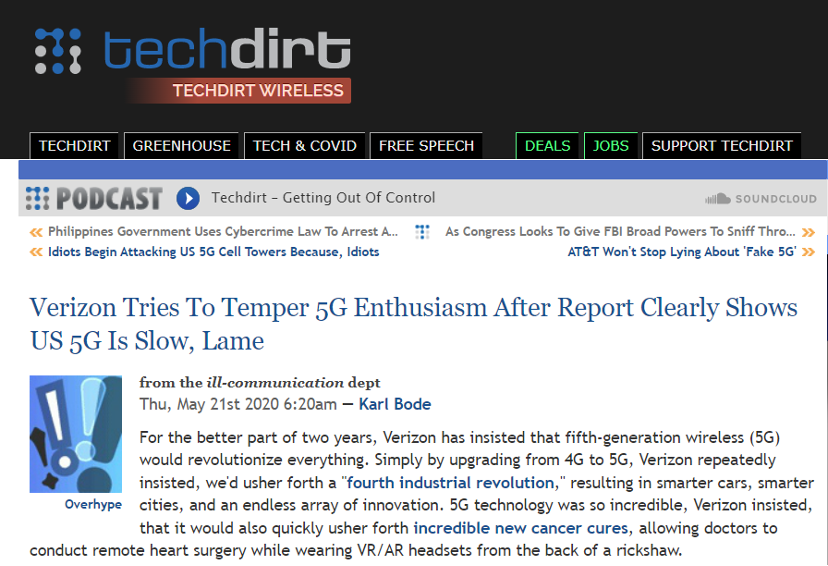
There is a problem though when you have only one product to sell, "Product as the Hero” becomes the sales strategy and I had a problem with that as an engineer who likes solving client problems. Both in my role there, and thereafter at consulting firms I worked for, I saw consultants and strategists develop databases of literally hundreds of use cases for 5G; all a pastiche of good intentions. 5G Telco tropes were so widespread at the time that https://www.techdirt.com was one of the first to call out the hype that “5G technology was so incredible, Verizon insisted, that it would also quickly usher forth incredible new cancer cures, allowing doctors to conduct remote heart surgery while wearing VR/AR headsets from the back of a rickshaw”.
The Challenge
5G operates across VHF, UHF, and EHF radio frequencies (RF). Electromagnetic energy is odorless, tasteless, cannot be seen or heard. We lack the sensory organs to even access it - so how do you sell something invisible? After years of my personal 5G frustrations and immune to the telco cool aid I was forced to find a deeper problem. My military clients have Terabyte-class workloads in edge compute domains; that means data piles up faster than it can be sent back. 5G was way too slow for them, “call me back when you have something stronger” I was often told. That put me on an entirely new path of research and design!
How do you make something better than it currently is? How do you offer additional value to make a technology more accessible? And lastly, how do you sell something unique when 5G is already everywhere?
In 2022 I was blessed to be leading a really talented team of design thinkers, curious technologists, and a rock star software developer (David if you’re out there we miss you!). Once we accepted 5G is too slow for our military clients we started researching ways to make it faster. As a result, Compression-as-a-Service (CaaS) was born. This allowed end users, not software developers, to layer compression into their current stack and pick from multi-modal engines that could autonomously pick the right compression algo, for the right data streams, and deliver it before it was needed by the commander. How’s 5G speeds on 3G networks sound? How does reducing your data-in-motion costs both in the cloud and in the air affect your OpEx?
The second discovery set the project in an entirely new and unexpected direction. What’s disruptive about 5G is not its speed, latency, or place in the electromagnetic spectrum. What’s disruptive about 5G is that is the first class of mobility that isn’t hardware-defined, it’s software-defined. With a background in DevSecOps, once I saw connectivity as code, it truly changes the way you see mission systems.
So I bought a tactical Pelican case and started building in my Boston apartment.
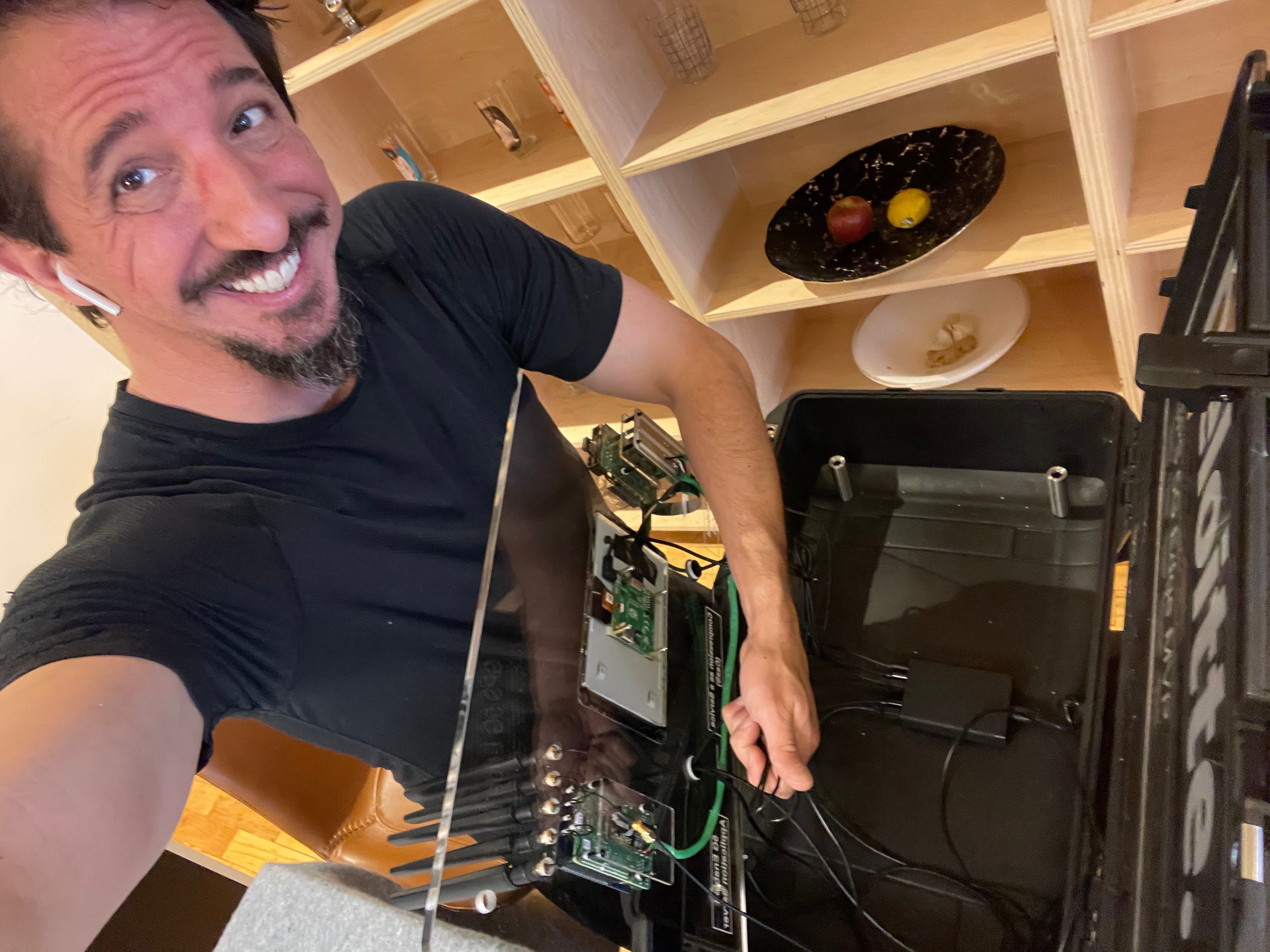
In 2022 for less than $1000 I created a Private 5G Network in a Box. This wasn’t a use case, it was the real deal. A functional 5G network I carried onto the plane and delivered it to a board room. I had a portable field-capable 5G datacenter on public 5G CBRS spectrum. Clients could interact with the 5G core on the touch screen as an immersive experience. I could demonstrate Compression-as-a-Service making my client’s big-data problems feel smaller reducing their data-in-motion costs. I could show how to bootstrap advanced connectivity to “dumb” devices and add them to the network. And lastly, my clients could see that connectivity is code and didn’t require massive datacenter to run. See it live in this video:
For those new to telephony, a 5G core is the software that runs a 5G network, it is comprised of lots of little Docker containers that run various micro services; that is what displays on the touch screen. This software is the backbone of any 5G network and my team found an open-source 5G core and started to modify it. We also learned there is Public 5G on the CBRS band that with a simple FCC license you can deploy private 5G on a military base, factory, college campus, etc.
So if anyone now asks you what’s disruptive about 5G, you can now tell them you can roll your own private network with a DevSecOps team and cut your telco costs. Connectivity is now code.
Lessons Learned
Thankfully we’re now all sobered and on the other side of the Gartner hype cycle on 5G. We can easily see that all those use cases and promises of a new industrial transformation were hype of a billion-dollar marketing engine. Here’s what I learned:
Building a physical prototype is worth 1,000 pictures.
Documenting the economic savings value of Private 5G was the solution, not the tech behind it.
The C-Suite doesn’t go shopping at the Use Case Store. Organizations invest in technologies that make them money or save them money.
5G is just an upgraded conduit for other technologies to use; it alone is not a solution. (Please remember this when 6G hype starts in a few years)
Smart factories, warehouses, etc. can’t use 5G in the way telco wanted because the transceiver chip sets (i.e. the 5G modem) are not inside the motherboard/equipment they already invested into (often 20-30 year lifecycles).
Billions are spent on hype cycles, real innovation comes from application of it in the real world making it better.