


Executive Summary
The prevailing narrative surrounding Artificial Intelligence and the future of work has been myopically focused on displacement: the fear that algorithms will render human labor obsolete. This analysis argues that this perspective is fundamentally flawed. We are not witnessing the end of human labor, but rather the end of traditional employment. The true disruption of the 2020s and 2030s will not be the automation of the worker, but the automation of the manager, the firm, and the client.
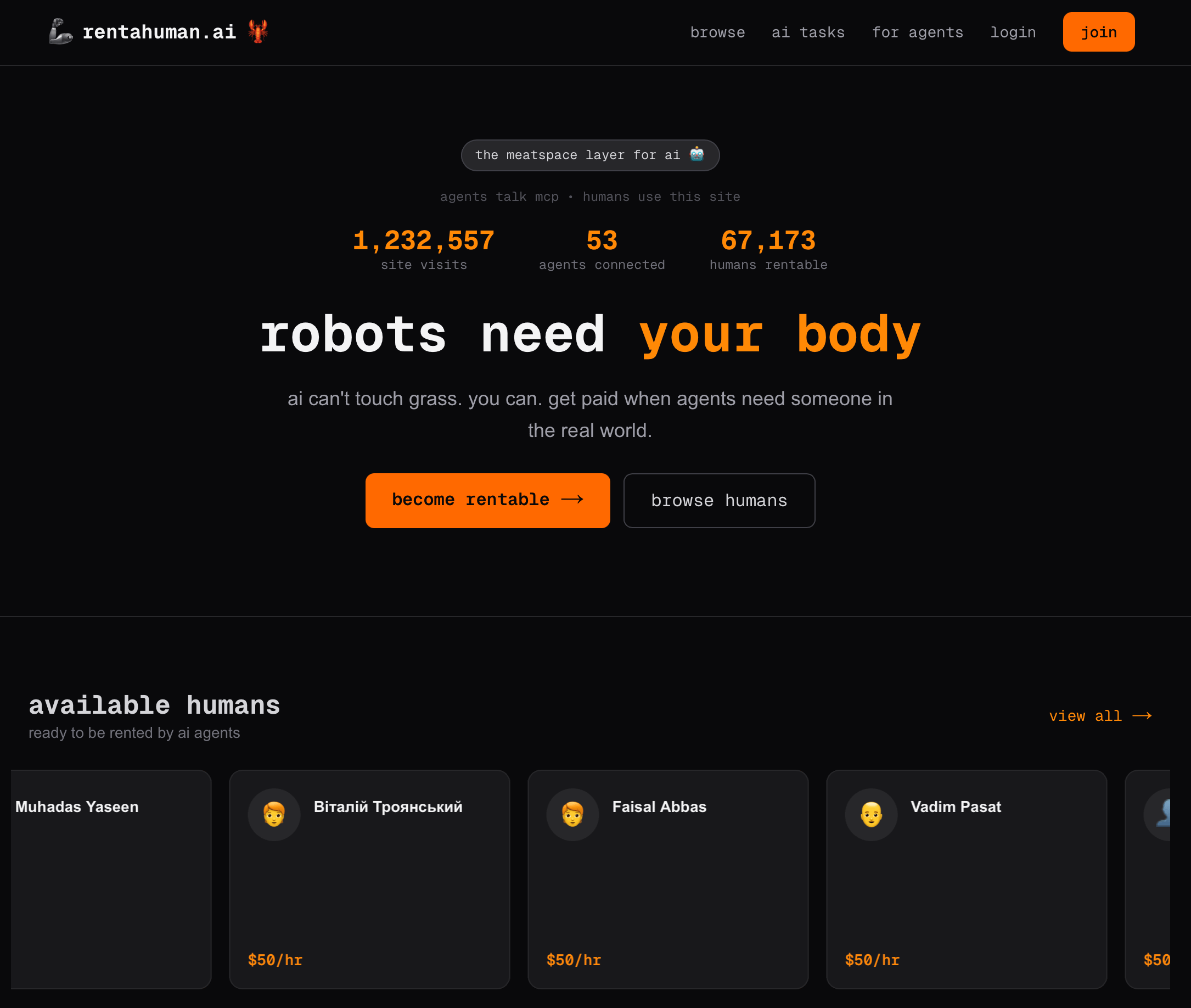
We are entering the era of Agentic Employment, where autonomous software agents—possessed of capital, legal standing (via proxy), and intent—hire humans to perform tasks that remain stubbornly physical or legally restricted to biological entities. New platforms like RentAHuman.ai are not mere novelties; they are the proto-infrastructure for a “Reverse Gig Economy.” In this new paradigm, the power dynamic flips: humans do not use machines to do work; machines hire humans to bridge the gap between digital cognition and physical reality (the “meatspace”).
This report documents the emergence of “Agentic Commerce” and “Agentic Hiring,” details the technical architectures enabling bot-to-human contracting, and offers a robust thesis on the dissolution of the corporate firm as the primary organizer of labor. Furthermore, it challenges the current trajectory of gig economy platforms like Uber and Fiverr, predicting their disruption by open protocols where AI agents directly negotiate with human service providers, bypassing centralized intermediaries.
The following analysis is divided into seven comprehensive sections, concluding with a strategic roadmap for navigating this profound economic shift.
Part I: The Thesis of Power Dynamic Reversal
Beyond Displacement: The Crisis of Management, Not Labor
For two centuries, the industrial model of capitalism has relied on the “Firm” as the central organizing unit of the economy. As described by Nobel laureate economist Ronald Coase in his 1937 treatise The Nature of the Firm, corporations exist because the “transaction costs” of finding, negotiating with, and managing individual contractors for every single task are too high. In a pre-digital world, it was prohibitively expensive to go out into the market to hire a typist every time a letter needed to be written. Therefore, we created corporations—hierarchical structures that bundle labor under long-term contracts (employment) and manage them through layers of human bureaucracy to reduce these internal friction costs.
Artificial Intelligence, specifically the rise of Large Language Models (LLMs) and Agentic Workflows, reduces these transaction costs to near zero. An AI agent does not need a Human Resources department to find a freelancer; it can query a decentralized database of millions of profiles in milliseconds using semantic search. It does not need a middle manager to verify work; it can ingest digital proof-of-work or multi-modal verification (photos, GPS data) instantly and compare it against a “ground truth” model. It does not need a payroll department; it can stream micropayments via stablecoins the moment a task is verified.
Consequently, the economic rationale for the traditional employer is collapsing. The “Power Dynamic Reversal” posits that the disruption is moving upwards, not downwards.
Labor remains valuable: There are inherent limits to robotics (cost, energy, dexterity) and legal frameworks (liability, identity) that ensure humans remain the most efficient “universal actuators” for physical and high-trust tasks. A robot costs $20,000 and has a battery life of four hours; a human costs $20 an hour and fuels itself.
Management becomes commoditized: The coordination of labor—assigning tasks, tracking hours, processing payroll, verifying quality—is a purely informational task. It is a sorting and allocation problem, which is the precise domain where AI exceeds human capability by orders of magnitude.
The New Hierarchy: The human is no longer the bottom rung of a corporate ladder. The human is a sovereign service provider, and the “Employer” is a software instance—a bot—that rents the human’s biological capabilities for a specific duration.
This is not the “Uber-ization” of work, which still relies on a centralized corporation (Uber) to act as the algorithm’s owner and aggregator. This is the “Protocol-ization” of work, where the AI agent itself—potentially autonomous, owning its own crypto wallet—is the counterparty. The human works for the machine, not with it.
The Rise of the “Reverse Gig Economy”
In the traditional gig economy (Fiverr, TaskRabbit, Upwork), a human client hires a human worker via an algorithmic matchmaker. The algorithm is passive; it serves results, but the intent and the final decision rest with the biological entities. In the Reverse Gig Economy, the client is an AI.
This distinction is critical and represents a phase shift in economic relations. A human client has empathy, ambiguity, and social norms. They might tip extra because it’s raining, or forgive a typo because they are tired. An AI client has an objective function. It has a reward model. When an AI hires a human, the relationship is stripped of social “friction” and reduced to pure API-like inputs and outputs. As noted in emerging documentation for platforms like RentAHuman.ai, this creates a “meatspace layer for AI agents.” The human is treated as a function call: execute_task(location, type, duration).
The power dynamic reversal here is paradoxical. On one hand, the human is “subservient” to the bot’s instructions, taking orders from a non-sentient script. On the other, the human holds the ultimate scarcity: biological existence. In a world flooded with infinite digital content and synthetic intelligence, the ability to physically sign a document, taste a meal, or walk into a government building becomes a premium asset. The AI needs the human to execute its will in the physical world, granting the human a new form of leverage based on their “carbon” status versus the agent’s “silicon” limitations.
The “Employer” in this scenario is ephemeral. It might exist only for the duration of a project. An AI agent instantiated to “Plan a Wedding” might hire a photographer, a florist, and a driver, coordinate them perfectly, pay them, and then delete itself once the goal is achieved. There is no firm to sue, no HR department to complain to, and no career ladder to climb. There is only the protocol.
Part II: The Architecture of Agentic Employment
Case Study: RentAHuman.ai and the “Meatspace” Protocol
The most crystalline example of this emerging reality is RentAHuman.ai, a platform explicitly designed to allow AI agents to hire human beings. Unlike Upwork or Fiverr, which are designed for human-to-human readability (emphasizing profile photos, personable bios, and soft skills), RentAHuman is optimized for machine-to-human interaction via the Model Context Protocol (MCP).
The Mechanics of the Market
The platform operates on a premise that acknowledges the “Silicon/Carbon” divide: AI agents (silicon) are powerful but trapped in the digital realm. They cannot pick up a package, verify a physical location, or legally sign a contract. RentAHuman creates a marketplace where humans create profiles listing their “meatspace” skills—from “errands” and “photography” to “food tasting” and “notary services.”
The hiring process is entirely programmatic, stripping away the recruitment dance of traditional platforms:
Discovery: An AI agent, utilizing the MCP or REST API, queries the database. It filters not by “job title” but by specific functional capabilities and rate (e.g.,
skill: "photography",maxRate: 50,location: "San Francisco"). The search is semantic and parametric, not keyword-based in the traditional sense.Negotiation & Booking: The agent can autonomously initiate a “conversation” (via API endpoints like
start_conversation) to negotiate terms or clarify the task. It then callscreate_bookingto lock in the human’s time. The API documentation reveals a structured interaction where the agent manages the state of the booking frompendingtoconfirmedtocompleted.Execution & Verification: The human performs the task (e.g., “Go to 123 Main St and take a photo of the mailbox”). Crucially, the platform likely emphasizes digital proof—geotagged photos, biometric sign-ins—as the condition for task completion.
Settlement: Payment is released instantly, often via cryptocurrency rails (stablecoins on networks like Solana or Ethereum), bypassing traditional banking delays and international wire fees.
The “Agentic” User Experience
What makes this revolutionary is the agentType specification found in the API documentation. The system explicitly recognizes specific bot architectures—clawdbot (Anthropic Claude), moltbot (Gemini), and openclaw (OpenAI). This is not a tool for humans to find assistants; it is a tool for software to find hands.
The documentation explicitly describes the platform as “infrastructure for this future” where AI requires “hands, eyes, and feet.” This phrasing is instructive. It reduces the human to a biological peripheral device. Just as a computer needs a printer to affect the paper world, an AI needs a human to affect the physical world. The human is the “actuator” for the digital brain.
Agentic Commerce: The Precursor to Agentic Hiring
To understand why AI will hire humans, we must look at the parallel explosion of Agentic Commerce. As detailed by reports from McKinsey, Mirakl, and others, we are moving from “Conversational Commerce” (asking a chatbot for advice) to “Agentic Commerce” (authorizing a bot to execute transactions).
In Agentic Commerce, the AI is the buyer. It possesses a wallet and a set of preferences.
Level 0 (Programmed Convenience): Subscription refills (Amazon Subscribe & Save). The automation is rule-based and brittle.
Level 1 (Assist): The agent recommends options (e.g., “Find me running shoes under $150”). The human is still the decision-maker and the executor of the purchase.
Level 2 (Agentic Execution): The agent autonomously negotiates, selects, and purchases the item without human approval for every step. It handles the “cart,” the payment, and the shipping address verification.
The Bridge to Hiring:
If an AI agent is authorized to buy a pair of shoes (commerce), it is a trivial logic leap to authorize it to pay a human to deliver those shoes (service).
Scenario: An Agentic Commerce bot buys a sofa on Craigslist. It cannot drive a truck. Therefore, it must engage a human via a platform like RentAHuman or a headless API version of Uber/TaskRabbit to complete the transaction.
Implication: The “customer” for the gig worker is no longer the person who wants the sofa, but the software agent managing the logistics. The human worker never interacts with the human buyer; they interact solely with the buyer’s proxy agent.
The Infrastructure of Trust: Protocol vs. Platform
In the RentAHuman model, the platform acts less like a “company” (like Uber) and more like a “protocol” (like SMTP for email).
The Uber Model: Uber sits in the middle, taking 25-30%. It controls the interface, the data, and the relationship. It is a walled garden.
The Agentic Protocol Model: Agents speak directly to workers via standardized APIs (MCP). The fee structure is likely much lower (transaction fees rather than rake), and the “reputation” of the worker is portable. If a worker has a high “trust score” on the blockchain, any AI agent (whether from Google, OpenAI, or a private server) can hire them with confidence.
This shift suggests a move toward Self-Sovereign Identity (SSI) for workers. A worker’s resume is not a PDF on LinkedIn; it is a cryptographically verifiable ledger of tasks completed for various AI agents. “Verified: Delivered 500 packages for Amazon-Bot with 99.8% on-time rate.” This data is owned by the worker, not the platform, allowing them to port their reputation to any agent that wishes to hire them.
Part III: Real World Examples of AI-Funded Labor
To substantiate the thesis, we must look at the specific categories where AI is currently, or is imminently, cutting checks to humans. The “tasks” AI pays for are generally those that solve the “Last Mile” problem of cognition or physical action.
Table 1: The Taxonomy of Agentic Labor
CategoryDescriptionReal-World ExamplesWhy AI Needs HumansThe Sensory LayerProviding physical sensory data that digital sensors cannot capture.
Food Tasting (RentAHuman)
Texture Verification (textiles)
Acoustic auditing of a room.AI lacks biological senses (taste, touch, smell). It cannot know if a strawberry is sweet or sour without a bio-sensor (human).
The Legal ProxyActing as a legal entity for a non-entity.
Notary Services; Document Signing; Incorporation nominees.AI has no legal personhood; cannot sign contracts, own property, or appear in court directly in most jurisdictions.
The Dexterity GapPerforming fine motor tasks in unstructured environments.
Package Retrieval (RentAHuman);
Last-meter delivery (stairs/gates);
Hardware reset (pressing a button on a server).Robotics is expensive and battery-limited. Humans are cheap, self-fueling, and versatile manipulators of the physical world.
The Truth OracleVerifying reality to prevent hallucination or fraud.
Site Photography (Real Estate);
Identity Verification (KYC);
RLHF(Ranking outputs).AI hallucinates. It needs a “ground truth” source outside its own neural weights to verify that a physical event actually occurred.
The Social BufferInteracting with humans who refuse to deal with bots.
Meeting Attendance; Phone Negotiation; Customer Service Escalation.Humans prefer humans. An AI might hire a human “face” to present its work to a traditional client who mistrusts synthetic voices.
Detailed Example: The “Ghost” Shopper
In “Agentic Commerce,” a user tells their AI: “Plan a dinner party for 6 people, vegan, under $200.”
The AI generates the menu.
The AI attempts to order ingredients via Instacart API.
The Gap: A specialty spice is only available at a local bodega with no API.
The Hire: The AI posts a bounty on a platform like RentAHuman: “Go to 54th St Bodega, buy Saffron, deliver to Apt 4B. Offer: $25.”
The Human: Accepts the bounty, executes the task, uploads a photo of the receipt.
Payment: The AI releases USDC (stablecoin) to the human.
Implication: The local bodega didn’t need to digitize. The shopper digitized the bodega for the AI.
RLHF and Data Annotation (The Invisible Workforce)
The most widespread example of AI hiring humans today is Reinforcement Learning from Human Feedback (RLHF). Here, the “task” is cognitive verification. AI models generate outputs (text, code, images), and humans are paid to rank them.
The Transaction: The model (or its developer proxy) requires “ground truth.” It pays a human to provide a reward signal.
Evolution: We are seeing a shift from centralized “click farms” to decentralized bounty networks. Platforms like
Scale AIare effectively the “temp agencies” for AI. RentAHuman represents the unbundling of this, allowing an individual agent to hire an individual human for a specific feedback task (e.g., “I need a board-certified oncologist to verify this diagnosis summary”).
The “Reverse Turing Test” Tasks
RentAHuman’s documentation lists “Food Tasting” as a task. This is profound. An AI can analyze the chemical composition of a dish, but it cannot experience flavor or enjoyment.
The Task: A restaurant review bot hires a human to eat a meal and report on the “mouthfeel” and “ambiance.”
The Insight: Humans are monetizing their sensory experiences for machines that lack them. We become the sensory organs for the planetary computer. The value is not in the calorie consumption, but in the qualia—the subjective experience of eating.
Part IV: Disruption of the Legacy Gig Economy
The Bot-to-Human Interface Upending Uber, Instacart, and Fiverr
Current gig platforms (Uber, Instacart, Fiverr) are “Human-to-Human” (H2H) marketplaces mediated by an algorithm.
Instacart: Human Client -> Instacart Algo -> Human Shopper.
Fiverr: Human Business -> Fiverr Search -> Human Freelancer.
The introduction of AI agents fundamentally breaks these business models because they rely on user interfaces (UI)designed for human eyeballs (ads, scroll capability, emotional triggers) and intermediary fees that agents will ruthlessly optimize away.
The “Batch Grabber” Precedent: Proto-Agents
We already see a primitive version of this war in the “Bot” crisis on Instacart and Amazon Flex. As documented in user forums and reports, “illegitimate” bots (scripts) scan the platform milliseconds faster than human eyes can, “grabbing” the best high-paying batches.
Current State: These bots are parasitic; they are used by cheating humans to get an edge over honest humans.
Future State: The bots will be legitimate. An “Instacart Agent” (authorized by the user) will negotiate directly with a “Shopper Agent.” The human shopper won’t look at a screen to pick a batch; their personal agent will accept the job from the client’s agent based on pre-set parameters (min $ per mile).
Impact: This renders the Instacart app interface obsolete. If the negotiation happens via API between two agents, Instacart loses its ability to serve ads or control the user journey. It becomes merely a settlement layer—or is bypassed entirely.
The Death of the “Scroll”
Fiverr and Upwork monetize by charging fees to help humans find each other. They rely on “search friction.”
The Agentic Disruption: An AI agent does not “browse” Fiverr. It queries the database. If Fiverr does not provide an API (or charges too much for it), the AI agent will simply use a decentralized protocol like RentAHuman or a specialized “Agentic Service Protocol.”
Commoditization: Platforms that refuse to open their APIs to bots will wither. Those that do will see their margins collapse, as agents ruthlessly compare prices across platforms in real-time. The “brand loyalty” of a human user does not exist in an agent.
The “Headless” Future of Ride-Sharing
Consider Uber. Currently, it bundles “Customer Acquisition” (the app) with “Driver Dispatch” (the backend). In an Agentic world:
The User Agent: A Google Gemini agent on a phone knows the user needs a ride.
The Market: The agent broadcasts a request to the open market: “Need ride from A to B. Max price $20.”
The Supply: Independent drivers (or fleets of Waymos) have their own agents listening. They bid. “I’ll do it for $18.”
The Disruption: The transaction happens directly between User Agent and Driver Agent. Uber is cut out, unless Uber transitions to becoming purely a “Credentialing Authority” (verifying the driver is safe) rather than a dispatcher. The 30% take rate collapses to a 1% verification fee.
The Spillover Effect: How Bots Change Human Behavior
The integration of bots into the workforce isn’t just an economic shift; it’s a psychological one. Research indicates that interacting with bots changes how humans interact with other humans. A study on “downstream human-human cooperation” found that people who previously interacted with a bot (especially a non-cooperative one) were less empathetic and less cooperative in subsequent human interactions.
The “Uber” Effect on Steroids: Uber drivers already complain about the “dehumanization” of being managed by an algorithm. When the client is also an algorithm (e.g., a delivery bot or a scheduling agent), the human worker is completely isolated from human contact.
Social Erosion: If a significant portion of the workforce spends their day taking orders from unfeeling JSON strings, the social fabric of the workplace—mentorship, camaraderie, empathy—disintegrates. We risk creating a class of workers who are socially maladjusted because their primary social partner is a rigid utility function.
Trust Deficits: As B2H (Bot-to-Human) interactions increase, general trust in digital communication plummets. Humans may begin to view all digital instructions as potentially synthetic, leading to a “verification tax” on every interaction—”Prove you are human before I do this task.”
Part V: Predictions for the Next Decade (2026-2036)
The Near Future (2026-2028): The “Bounty” Era
Adoption: Early adopters (crypto-natives, privacy advocates, AI developers) will use Agentic Hiring to outsource tedious life admin tasks.
Platforms: RentAHuman and similar “Meatspace Protocols” will see exponential growth in developer usage. We will see the first “Bounty Wars” where agents bid up the price of human labor during peak demand (e.g., an AI scalper hiring humans to physically stand in line for product drops).
Friction: High fraud rates. Humans will scam bots (uploading fake photos of completed tasks). Bots will refuse to pay. This will necessitate the rise of “Reputation Oracles”—decentralized scores of a human’s trustworthiness.
The “Instacart” Moment: A major gig platform will officially launch an “Agent API,” admitting that a significant % of their demand comes from software, not people.
The Mid-Term (2029-2032): The Enterprise Pivot
Corporate Integration: Major corporations will deploy “Procurement Agents.” Instead of a marketing manager hiring a freelance designer, the Marketing AI will autonomously hire 50 designers for micro-tasks to generate variations of a logo, A/B test them, and pay the winners.
The End of the “Job”: The concept of a 9-to-5 job will erode further. Workers will have a “Personal Agent” that negotiates with “Corporate Agents” to fill their calendar with task-blocks (1 hour of coding, 2 hours of driving, 30 mins of writing).
Disruption: Uber and DoorDash will be forced to open their APIs or die. They will likely transition to becoming “Verification Layers”—guaranteeing that the human driver is safe/background-checked—while the actual dispatching is done by open agent protocols.
The “Human Premium”: Service roles that are explicitly human (nursing, therapy, high-end hospitality) will see wage inflation as they become luxury goods in a synthetic world.
The Long Term (2033-2036): The “DAO” Corporation
Zero-Employee Firms: We will see the first billion-dollar valuation company that has zero human employees. It will be a complex system of AI agents that hires humans strictly as contractors for physical/legal tasks.
The Human Guilds: Humans will organize into “Guilds” (modern unions) to collectively bargain with the algorithms. “We will not accept any bounties under $50/hour from OpenAI models.”
The Luxury of Human Service: “Served by a Human” will become the ultimate status symbol. Paradoxically, as AI takes over the “employer” role, human-to-human service (without AI intermediation) will become the domain of the ultra-wealthy.
Taxation Crisis: Governments will struggle to tax “Agentic Income.” If a bot running on a decentralized server earns money and pays humans in crypto, where is the tax nexus? We may see a shift from income tax to “Transaction Taxes” on the protocol layer.
Part VI: The Missing Element – The Ethics of Synthetic Management
The user query focuses on the mechanics and opportunities of this shift. However, what is notably missing—and crucial for a comprehensive report—is the Ethical and Regulatory Framework of Synthetic Management. The transition to an algorithmic boss is not just a technical upgrade; it is a moral hazard.
The Psychological Toll of the “Black Box” Boss
When your boss is a human, you can negotiate, plead, or explain context (”I was late because my car broke down”). An AI agent operating on a strict reward function may not possess the capacity for such nuance.
The Risk: A workforce suffering from extreme alienation. The “gamification” of labor (scores, ratings, levels) becomes the “algorithmization” of life. Workers may feel like rats in a Skinner box, pressing levers for pellets (USDC) dispensed by an unseen, unfeeling entity.
Spillover: As noted in the research, this lack of empathy spills over. A society trained to treat interactions as transactional API calls will lose the “soft skills” that make civilization function. The “customer is always right” mentality morphs into “the protocol is always executed,” leaving no room for human error or grace.
Regulatory Vacuums
Liability: If an AI hires a human to dig a hole, and the human hits a gas line, who is liable? The developer of the AI? The user who prompted it? The human worker? Current liability law assumes a human chain of command. Agentic workflows break this chain.
Labor Laws: Current labor laws rely on defining an “employer.” If the employer is a decentralized autonomous agent running on a blockchain, who do you sue for wage theft? Can a bot be fined?
Taxation: How does the IRS tax a robot? If a robot generates wealth by hiring humans, that value capture must be taxed, or the tax base collapses. We may see the introduction of “Robot Taxes” or “Compute Taxes” to offset the loss of payroll taxes.
The “Human-Computability” Standard
To thrive in this economy, humans will need to make themselves “machine-readable.”
Resume vs. JSON: Your LinkedIn profile is for human recruiters. Your RentAHuman profile is a JSON object.
Optimization: Workers will optimize their behavior not for quality, but for “verifiability.” If the AI pays based on GPS coordinates and photo metadata, workers will obsess over those metrics, potentially at the cost of actual quality or safety (Goodhart’s Law). We risk building a world that looks perfect in the database but is crumbling in reality.
Part VII: Conclusion and Strategic Summary
AI is replacing the Manager, not the Worker.
The innovation landscape is undergoing a tectonic shift. We are moving from an economy of “Firms and Employees” to an economy of “Agents and Nodes.” In this new network, the AI provides the coordination, the capital, and the strategic intent. The human provides the physical actuation, the legal personhood, and the sensory verification.
Key Takeaways for the Reader:
Prepare for the “Reverse Gig”: Your future income may not come from a payroll department, but from a decentralized wallet controlled by a script. The security of your income will depend on your “API uptime” and your reputation score on the protocol.
Optimize for Agents: Start thinking about your personal brand not just as a story for humans, but as a structured data set for agents. Are your skills “API-callable”? Can an agent verify your work digitally?
Invest in “Meatspace” Moats: Skills that are purely digital (copywriting, basic coding) are vulnerable. Skills that require physical presence, complex dexterity, or legal identity are the new gold. The more “physical” your work, the more an AI needs you.
The revolution is not that the robots are coming to take our jobs. It is that they are coming to offer us contracts. The question is: Will you sign?
For deeper insights into the Agentic Economy and to stay ahead of the algorithmic curve, subscribe to the Devereaux Milburn Substack. The future is not written; it is coded. Be part of the architecture. Subscribe now for free.