
LinkedOut | The Tinderification of Professional Life
My manifesto and final post from LinkedIn before moving to Substack

Clients, Colleagues, Friends, Fans,
It’s been 22 years. I signed up for LinkedIn 22 years ago and after decades of positive intent and effort, I’ve yet get any modicum value for feeding this machine. I surrender - this is my last post.
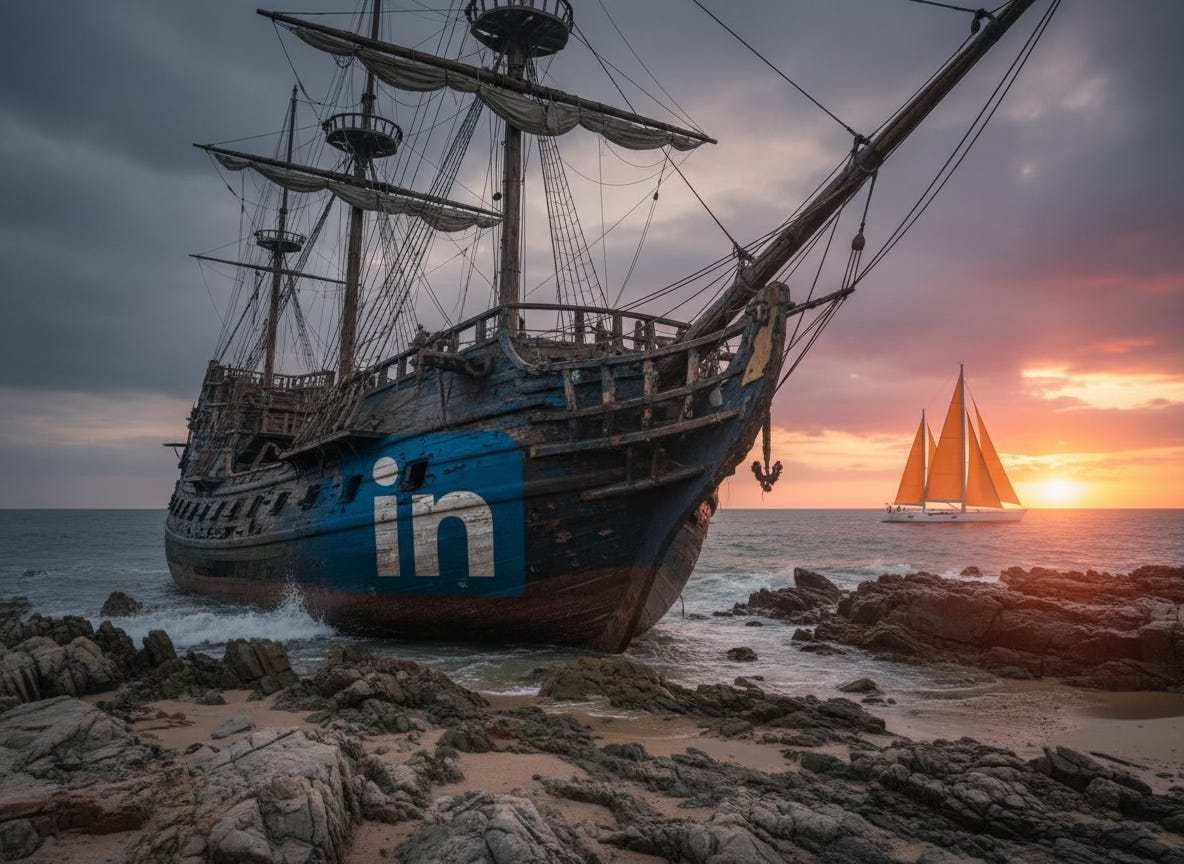
When the platform rewards bots posting corporate thirst traps over thought leaders in the industry, when the algo promotes AI slop more than real business content, and when the platform becomes a haven for ghost jobs, I have to accept it is a ship that has run aground.
The transformation of LinkedIn from a static, utility-based digital rolodex into a hyper-active, dopamine-driven social feed represents a calculated pivot in behavioral engineering. This shift, often colloquially termed “Tinderification,” is not merely an aesthetic modernization but a fundamental restructuring of how professional value is signaled and consumed. By adopting the gamification mechanics and variable reward schedules pioneered by dating applications and casino game design, the platform has engineered a user experience (UX) that prioritizes time-on-site, the attention economy, and ad inventory exposure over the efficiency of professional outcomes (the original mission).
The platform’s aggressive growth strategies rely heavily on “dark patterns”—interface designs carefully crafted to trick users into taking actions they might otherwise avoid, or to make disengagement difficult. These patterns prioritize corporate growth metrics over user agency and consent. The degradation of LinkedIn’s content ecosystem is not accidental or merely a result of user behavior; it is the direct result of algorithmic choices that prioritize “dwell time” and viral engagement over professional substance. This has led to the proliferation of “AI slop”—low-value, machine-generated text—and the “broetry” format, creating a “Dead Internet” environment where bots converse with bots (a self-licking ice cream cone) to the detriment of all of our professional needs.
LinkedIn’s algorithm aggressively penalizes external links, effectively trapping knowledge within the platform to maximize ad exposure. To succeed, users must post zero-click content—threads and carousels that keep the reader on LinkedIn.This discourages the sharing of deep research, external portfolios, or primary sources, and encourages the creation of self-contained, often superficial, hot takes that fit within the platforms constraints. Furthermore, the algorithm rewards comments over likes, leading to the rise of engagement pods—groups of users who agree to comment on each other’s posts immediately upon publication to trick the algorithm into boosting the content. While LinkedIn claims to fight this, the structural incentives make it the only viable strategy for organic reach, forcing even honest professionals to engage in engagement hacking to maintain visibility.
Recent feature additions, such as “streaks” for daily usage or posting consistency, hijack the user’s cognitive bias toward loss aversion. The platform frames a day of non-usage not as a break, but as a “loss” of accumulated progress. This creates a form of “digital Stockholm Syndrome,” where the user feels an obligation to the platform to maintain a metric that has no external value or correlation to professional success. The result is a flood of low-quality, daily content produced solely to satisfy the algorithm’s demand for consistency, turning professional discourse into a daily compliance task performed for the benefit of the platform’s engagement statistics.
Perhaps the most fraudulent and economically damaging aspect of the modern LinkedIn ecosystem is the prevalence of “ghost jobs”—job listings for positions that do not exist, or which the employer has no intention of filling in the near term. Companies use ghost jobs at best as cheap marketing, and worst to harvest data. This phenomenon has distorted labor market data, wasted millions of hours of human capital, and transformed the act of job seeking into a performative ritual of futility.
The tragedy of LinkedIn is that it has become too big to fail for many professionals. It holds a monopoly on the digital resume and the professional graph. Leaving implies professional death or invisibility. This monopoly power allows LinkedIn to ignore user hostility. They know users hate the broetry, the ghost jobs, and the AI slop, but they calculate that the cost of leaving is too high. This is the definition of a rent-seeking monopoly: an entity that extracts value not by innovating, but by owning the toll road that everyone is forced to use. The degradation is not a mistake; it is the business model working as intended in its final stage.
LinkedIn is a compromised asset. It is “rented land” where the landlord (Microsoft) actively degrades the soil quality while raising the rent. The professional imperative for 2026 and beyond is Digital Sovereignty—the ownership of one’s audience, data, and distribution channels. The decomposition of LinkedIn is not a temporary glitch; it is the terminal phase of its business model. The “Tinderification” of connection, the institutional fraud of ghost jobs, and the harvesting of private data for AI are features, not bugs, of a system designed to extract value from human professionals rather than empower them. Continuing to invest primarily in a LinkedIn presence for me is to build a house on eroding sand. The algorithm does not care about your career; it cares about your dwell time. The “ghost job” poster does not care about your talent; they care about their resume database. The platform does not care about your privacy; it cares about its AI training data.
Substack has emerged as the primary vehicle for this exodus. It represents a structural inversion of the LinkedIn model, prioritizing direct connection over algorithmic mediation. The move to Substack—or any owned, direct-to-audience platform—is a declaration of independence. It is a refusal to perform the “dance of the progress bar” or write “broetry” for the machine. It is a return to the original promise of the internet: direct, human-to-human connection, unmediated by the perverse incentives of profit-over-end user outcomes.
I have launched TikTok, YouTube, and Substack channels and will be posting there from now on. Please follow in your preferred way and thank you all for your support!
Devereaux Milburn | Founder & Chief Innovation Officer
XERAPHINA
Thanks for the article, yes it is indeed an advanced Skinner Box, we see such dark patterns in a lot of platforms. If it is free, it means you are the product.
Gold gold absolute gold for my scientific business leadership presence. Thank you for writing this ❤️👍