
The Black Swan Event of AI - The White-Collar Wipeout Will End at Your Front Door
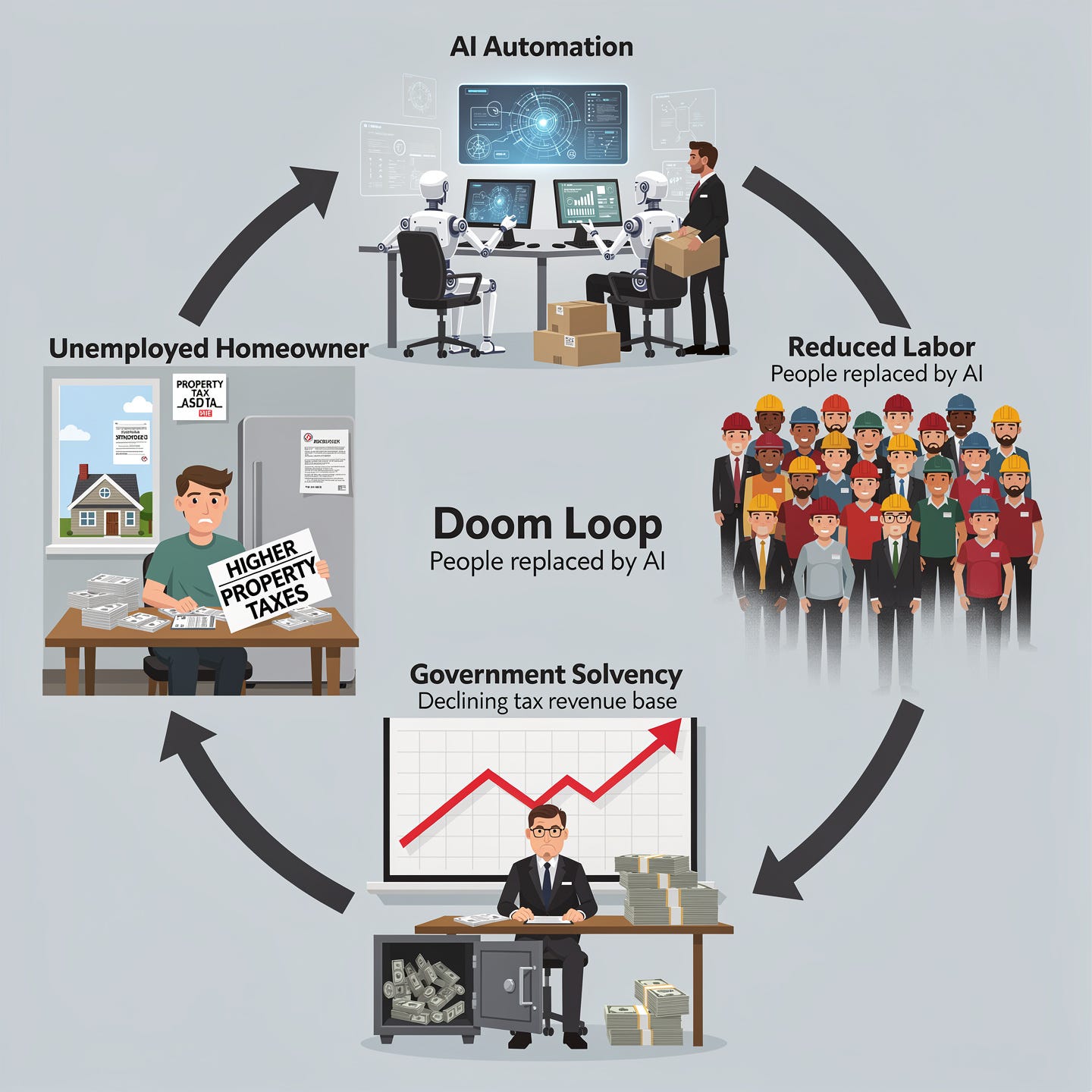
Preparing yourself for the doom loop between Automation, Labor, Government Solvency, and the financial cliff awaiting the Homeowner

Primer
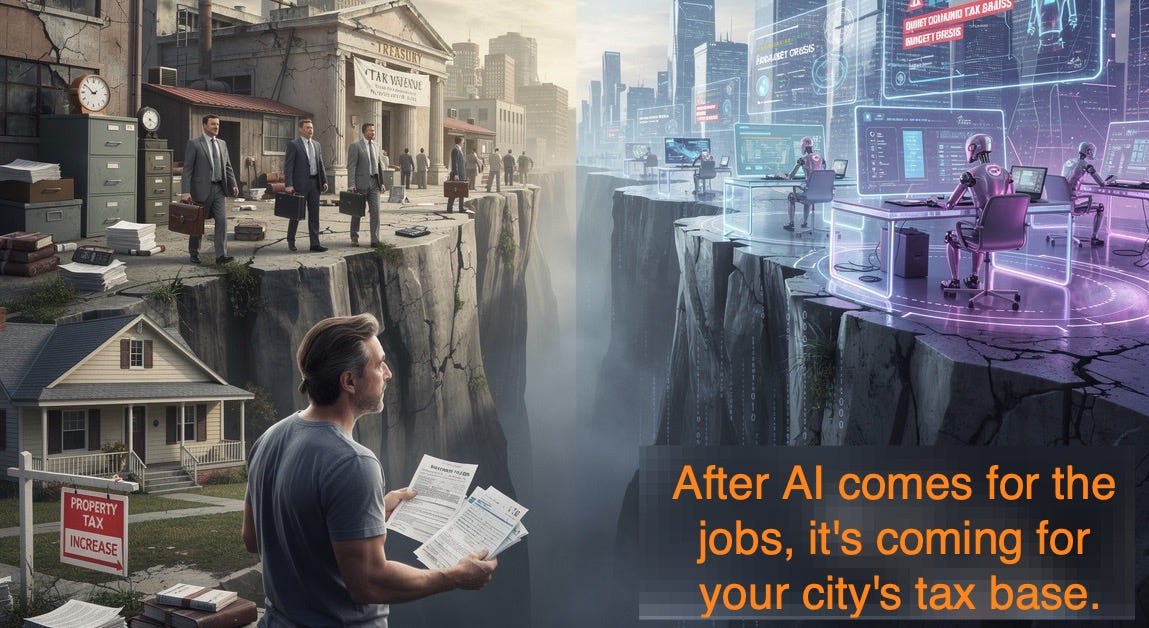
Everything is theoretically impossible, until it happens. No one could have believed in 2006 what home prices would be after the 2008 financial collapse, and I’m telling you right now, that your home value is about to crash in the next few years. Are you ready for your property tax to double as well? Next imagine entire government services suspended and the social upheaval that would ensue.
To understand the cascade failure about to happen one has to understand that Game Theory is the motion between actors and factors. As the largest capital investment in the history of humanity, Artificial Intelligence is moving at a velocity that is hard to keep up. As a career innovator with 25 years in tech we are trained to look 2-3 cycles ahead and position for those potential gamed realities; including the threats. When I did the math this time, I saw something that so disruptive that I debated whether to even write this article or make the interactive infographic because it was terrifying. My goal in writing this was not to make you afraid, but to make you prepared.
Bottom Line Up Front
As AI eliminates white collar jobs automating organizational OpEx to zero, it also drives the payroll/income tax base to zero. Under the current structures, a painful upcoming transition between the Employer, Employee, the State and the Homeowner will be required.
Breakdown of Federal Tax Revenue:
Individual Income Tax: 49% - 52%
Payroll Taxes (Social Insurance): 30% - 36%
Corporate Income Tax: 9% - 11%
Other (Excise, Estate, Customs): ~5%
Thus, when AI decimates the white collar workforce, what are the 2nd and 3rd order effects of AI reducing tax revenues of a labor market automated out of a paycheck? How will the social services governments provide to citizens dramatically change when tax revenues plummet? Lastly, how much faster will this all happen with the increased demand for unemployment straining government budgets that were not designed for the mass extinction of the knowledge worker?
Understanding AI as a Self-Consuming Industry
I may have a technical background in software but you do not have to. All you need to know is that software developers are using AI to build software that eliminates the need for entire departments that used to participate in software design and making you the products and services you use every day. But the deeper paradox is more profound and no one is talking about it yet: AI is building software that eliminates the need for the software that required humans in the first place. There’s no GUI if the end user is now AI.
CONSIDER:
If AI can code and deploy an entire 2-week Agile sprint of software in an hour, do we need the Scrum Master, Product Owner, team manager, and productivity loss of everyone in meetings to talk about it?
If AI can handle customer inquiries directly, do we need CRM/Salesforce software or the SaaS expense?
If AI can manage projects autonomously, why do we need the expense of JIRA or the Project Manager anymore?
THE CHALLENGE: When AI is obviating the need for humans in the workplace, what are the 2nd and 3rd order effects to the Employer-Employee-State triad?
Click to play triad infographic video
The Employer’s Dilemma
Leaders are hearing “adopt AI or lose to those who do.” Shareholders demand profits and growth. While reducing workforce (OpEx) through automation is a traditional way to tip the P&L scales, it’s not sustainable as a long-term growth strategy. We’re also seeing weekly mass layoffs across verticals that aren’t normally connected indicating a larger sea change in the way companies value/devalue human capital.
The Municipality’s Dilemma
As high-income knowledge worker roles get replaced by AI, income and payroll tax revenues collapse. Additionally the unemployment system was never designed for layoffs at the scale we’re experiencing which is a double strain on government budgets. Add it the physical cost of running a city (roads, police, fire, sanitation, snow removal, etc.) does not decrease; in fact, it increases with social instability. Cities cannot tax robotic labor directly (a Federal mandate) like some in France have discussed doing as factory robotic replacements replace those paying into the pension fund. Their only remaining lever is the Property Tax—levied on the one asset that cannot move: the home. Just look at how New York City currently faces a severe structural budget shortfall totaling roughly $12.6 billion across Fiscal Years 2026 and 2027 and Mayor Zohran Mamdani proposing to raise property tax rates in New York City by nearly 10 percent.
The Homeowner’s Trap
Displaced white-collar professionals are often “Asset Rich, Cash Poor.” They own homes purchased during the high-wage era pre-AI. As cities drastically hike property taxes to cover budget deficits, these unemployed homeowners face a liquidity crisis. This forces a sell-off, depressing real estate values, which ironically forces the city to raise rates even further to maintain revenue neutrality. This is the Doom Loop of the 2030s where governments have to close budget gaps and move to increasing property taxes before they figure out how to implement VAT to corporations.
The Problem Domain: Structural Decoupling
The relationship between employees, employers, and tax-funded government services has remained relatively stable since WWII. Workers provide labor, employers compensate them, governments tax those wages to fund public services, and those services support the workforce. Employees used those wages to consume goods and pay taxes; and the State used those taxes to fund public services, infrastructure, and the education systems that produced more skilled labor.
This circular economic model is facing its most significant disruption since the Industrial Revolution. Unlike previous automation waves that primarily affected manual labor, AI is automating cognitive work at an unprecedented scale and speed gutting the frozen middle of large organizations. We are moving from a system where labor was the primary driver of value creation (and payroll/income tax revenue) to one where intelligence and compute are the drivers (thus sales tax on hardware).
Adding to this is the intersection of AI with major advancements in robotics. Hyundai Motor Group holds an 80% controlling stake in Boston Dynamics who can now produce 30,000 robots Atlas robots per year automating physical labor in their factories. Blue collar and trade professions are now under threat to be automated.
Both of these workforce disruptions break the “Keynesian Loop” where wages fuel consumption, including homestead solvency. This report examines six critical dynamics that will reshape our economic landscape from 2026 to 2036. I analyzed the cascading effects of AI automation on employment, organizational structures, individual careers, tax revenue, government budgets, and household stability. My approach uses game theory to map the interactions between these forces, providing year-by-year predictions grounded in current trends and economic modeling. The goal is neither optimism nor pessimism, but realistic preparation. Understanding these dynamics enables individuals, organizations, policymakers, and my clients to make informed decisions about the decade ahead.
The Decade of Transformation
The following timeline is not a worst-case scenario, but a projection of current trajectories based on Game Theory. As organizations (rational actors) adopt agentic workflows to reduce OpEx, they trigger a cascade of 2nd and 3rd order effects that destabilize the traditional labor-tax-service model. This decade marks the transition from the “Knowledge Economy” to the “Agency Economy,” where the ability to execute in the physical world becomes the primary driver of value.
Phase 1: The Junior Wipeout
INTEGRATION
Fact: AI automates up to 60% of boilerplate code.
Prediction: Hiring for “Junior Developer” and “L1 Support” drops by 75%.
Hypothesis: The apprenticeship model breaks. Seniors have no one to mentor.
📉 Dying Careers:
Junior Software Dev
Manual QA Tester
L1 Helpdesk Support
Basic Copywriter
Entry Data Analyst
📈 Emerging Careers:
AI Prompt Engineer
Vibe Coder
LLM Fine-tuner
Model Output Verifier
Synthetic Data Specialist
Phase 2: SaaS Consolidation
TOOL REPLACEMENT
Fact: Custom AI Agents replace niche SaaS subscriptions.
Prediction: Organizations cancel 30% of B2B software seats.
Hypothesis: Software moves from “Rent” (SaaS) to “Build” (Internal Agency).
📉 Dying Careers:
SaaS Sales Rep (SDR)
Customer Success Mgr
Salesforce Admin
Technical Writer
SEO Specialist
📈 Emerging Careers:
Agent Architect
Internal Tool Builder
Knowledge Graph Eng.
API Integrator
Legacy System Wrapper
Phase 3: Middle Management Crunch
FLATTENING
Fact: AI agents can schedule, report, and track status.
Prediction: Project Manager and Middle Manager roles are cut by 50%.
Hypothesis: “Coordination” is no longer a human value-add.
📉 Dying Careers:
Project Manager
Middle Manager
Agile Coach/Scrum Master
Business Analyst
HR Generalist
📈 Emerging Careers:
Strategic Orchestrator
Human-AI Liaison
Organizational Psychologist
Workflow Automator
Chief Efficiency Officer
Phase 4: Professional Crisis
WHITE COLLAR RECESSION
Fact: LLMs surpass median human performance in Law, Accounting.
Prediction: 40% of Paralegal, CPA, and Analyst tasks are automated.
Hypothesis: “Knowledge Work” is commoditized.
📉 Dying Careers:
CPA / Accountant
Financial Analyst
Radiologist (Diagnostic)
Translator / Interpreter
Legal Associate
📈 Emerging Careers:
Human Judgment Arbiter
Complex System Strategist
Niche Expertise Consultant
Personal Brand Architect
Forensic AI Accountant
Phase 5: Property Tax Pivot
HOMEOWNER SQUEEZE
Fact: Local Municipalities cannot print money like the Feds.
Prediction: Property tax hikes of 40% to plug budget gaps.
Hypothesis: Homeownership shifts from asset to liability.
📉 Dying Careers:
Real Estate Agent
Mortgage Broker
Title Researcher
Property Appraiser
Loan Officer
📈 Emerging Careers:
Housing Utilization Consultant
Co-living Architect
Distressed Asset Mgr
Municipal Insolvency Spec.
Phase 6: New Equilibrium
STABILIZATION
Fact: Tax systems overhauled.
Prediction: VAT & Compute Taxes fund state.
Hypothesis: The Triad stabilizes on new nodes.
📉 Dying Careers:
Tax Preparer
Audit Clerk
Payroll Specialist
📈 Emerging Careers:
Reality Architect
Space Industry Tech
Fusion Plant Operator
Synthetic Bio-Eng
Robot Tax Auditor
Conclusion
The “Sky is not falling,” but the ground is definitely moving. The AI “bubble” pop is not going to be in the AI industry, but rather in the bubble popping our lifestyle and economics built around knowledge workers getting paid for specialized skills and contributing to the tax base. The structures of the 20th century—the 40-hour work week, the payroll tax-funded state, the degree-based career ladder—are incompatible with the physics of the AI age of the new 21st century. The winners of the next decade will not be those who try to preserve the old system, but those who build the infrastructure for the new one; let’s start building.
Generated by XERAPHINA Analytics | 2026 Prediction Model
Access the online interactive poster version of this report for free below at
https://www.xeraphina.com/media/The%20Kinetic%20AI%20Triad%20and%20The%20Decade%20of%20Displacement.html
